Gravel Calculator
Work out cubic yards, tons and cost for a driveway, path or patio base. Suppliers sell by the ton, so the conversion matters.
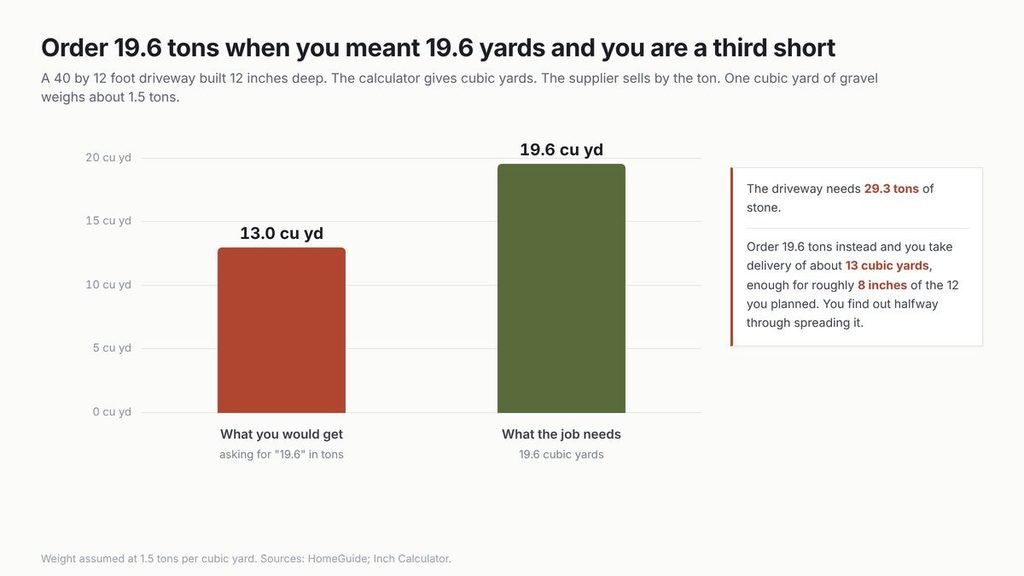
The most expensive mistake people make with gravel is not choosing the wrong stone. It is ordering the right number in the wrong unit. A gravel calculator gives you cubic yards. Your supplier sells by the ton. Those are not the same thing, and getting them confused leaves you about a third short with the delivery truck already gone.
This guide covers how much you need, what it costs, how deep a driveway has to be, and which gravel belongs in which layer.
How Much Gravel You Need, Step by Step
Four steps, and you can do them on paper before anyone quotes you.
One. Multiply length by width in feet to get square feet. A 40 by 12 foot driveway is 480 square feet.
Two. Multiply by depth in feet. Inches become feet by dividing by 12, so 12 inches is 1 foot and 4 inches is 0.333. At a full 12 inches, 480 × 1 = 480 cubic feet.
Three. Divide by 27 to get cubic yards, because a cubic yard is 27 cubic feet. That gives 17.78 cubic yards.
Four. Add 10 percent. Gravel settles as it compacts, some spills during spreading, and the ground is never perfectly flat. That takes you to 19.56 cubic yards.
That is the figure a gravel calculator produces. It is not yet the figure you give the supplier, and the next section explains why.
Tons or Yards? This Is Where People Go Wrong
Gravel is sold by weight and calculated by volume. One cubic yard of gravel weighs roughly 1.4 to 1.7 tons, or 2,800 to 3,400 pounds, depending on the stone and how much fine material is mixed in.
So the 19.56 cubic yards above is about 29.3 tons at an average 1.5 tons per yard. Phone the supplier and ask for 19.5 tons because that is the number in front of you, and you will take delivery of roughly 13 cubic yards. That is two thirds of a driveway. You will discover it somewhere around the halfway point.
The conversion in both directions:
| Material | Tons per cubic yard | Pounds per cubic yard |
|---|---|---|
| Pea gravel | about 1.4 | around 2,800 |
| Crushed limestone | about 1.5 | around 3,000 |
| Crusher run | about 1.6 | around 3,200 |
When you order, say both numbers out loud. “Nineteen and a half cubic yards, which I make about twenty nine tons.” Any decent supplier will correct you on the spot if your conversion is off for their particular stone, and that thirty second conversation is the cheapest insurance on the whole job.
How Deep a Gravel Driveway Needs to Be
Most people underbuild this badly. A gravel driveway is not a layer of stone on dirt, it is a structure, and it wants to be 8 to 12 inches deep built in three distinct layers of decreasing stone size.
| Layer | Depth | Stone size | Job |
|---|---|---|---|
| Sub-base | 4 inches | Fist sized | Carries the load and drains |
| Middle | 4 inches | Golf ball sized | Locks into the layer below |
| Surface | 4 inches | About 3/4 inch | Drives and walks comfortably |
The reason the sizes decrease is mechanical rather than cosmetic. Large angular stone at the bottom creates voids that water drains through instead of sitting in and freezing. Each smaller layer wedges into the gaps of the one below, so the whole thing locks together rather than shifting under a tire. The Federal Highway Administration describes the same principle at road scale in its tech brief on bases and subbases for pavements, including why that bottom layer doubles as frost protection.
A 4 inch driveway will look fine for one season. Then the stone works its way into the soil, ruts form where the tires run, and you are buying gravel again every spring. The deeper build costs more once and then stops costing.
How much depth you actually need also depends on what sits underneath. You can look up the soil at your own address, free, on the USDA’s Web Soil Survey. Clay and poorly drained ground want the full 12 inches and a layer of geotextile fabric underneath. Well drained sand or native gravel will forgive a shallower build.
What Gravel Costs
Gravel runs $10 to $50 per ton, or $15 to $75 per cubic yard, depending on the stone, how much you take and how far it travels. Delivery is usually quoted separately at $7 to $18 per cubic yard.
By material, for the stone itself:
| Material | Per ton | Per cubic yard | Per square foot |
|---|---|---|---|
| Crusher run | $24 to $34 | $51 to $54 | $0.50 to $2.00 |
| Crushed limestone | $30 to $38 | $35 to $54 | $1.48 to $2.00 |
| Pea gravel | $28 to $45 | $29 to $86 | $1.00 to $3.19 |
For a finished driveway with labor included, budget $1 to $3 per square foot. That 40 by 12 driveway therefore lands somewhere between $480 and $1,440 installed, with the spread driven mostly by depth and how much site preparation the ground needs.
If you are pricing other outdoor work at the same time, our guide to concrete cost per yard covers the alternative surface and why its pricing works completely differently.
A Worked Example: 40 by 12 Driveway
Running one real job all the way through is more useful than any amount of theory, so here is a standard single car driveway, 40 feet long by 12 feet wide, built properly at 12 inches in three layers.
The area is 480 square feet. At 12 inches that is 480 cubic feet, which divided by 27 gives 17.78 cubic yards, and adding the standard 10 percent brings it to 19.56 cubic yards.
Converted to the unit the supplier actually uses, at roughly 1.5 tons per cubic yard, that is 29.3 tons. Split across the three layers it works out at about 9.8 tons each, though in practice the base layer often takes a little more because it is filling the unevenness of the ground beneath.
| Item | Quantity | Cost |
|---|---|---|
| Base layer, crusher run | about 9.8 tons | $235 to $333 |
| Middle layer, crushed stone | about 9.8 tons | $294 to $372 |
| Surface layer, 3/4 inch stone | about 9.8 tons | $294 to $372 |
| Delivery, 19.56 cubic yards | at $7 to $18 per yard | $137 to $352 |
| Materials delivered, total | 29.3 tons | $958 to $1,429 |
Compare that with the same driveway built the way most people build one, a single 4 inch layer of surface stone. That needs 6.52 cubic yards, about 9.8 tons, roughly $330 of material. A quarter of the cost, and it will rut within two winters and need topping up every spring thereafter. The cheap version is only cheap in year one.
Note what the gravel calculator above does with this. Enter 40, 12 and 12, pick your material, and it gives you cubic yards, tons and a material cost in one step, with the 10 percent already added.
Which Gravel Goes Where
Crusher run, sometimes sold as road base or quarry process, is crushed stone mixed with stone dust. The dust is the point: it fills the voids so the material compacts into something almost solid. Use it for driveway base layers and under pavers. Do not use it where water needs to drain through. Where drainage is the whole point, open graded stone with the fines screened out is used as a water reservoir instead, which is the approach the EPA sets out in its guide to permeable pavement.
Crushed limestone or crushed stone is angular with the fines screened out. The sharp edges lock together, which is why it stays put on a slope. This is your driveway surface layer.
Pea gravel is small, rounded and smooth. It looks lovely and it is comfortable underfoot, which makes it good for paths, play areas and decorative beds. It is poor for driveways precisely because it is rounded, so it rolls rather than locking, migrates toward the edges and scatters when a car turns on it. If you want pea gravel on a drive, it needs edging to hold it in.
Delivery, Minimums and the Small Load Problem
Whatever number the gravel calculator gave you, check it against the delivery minimum. Most suppliers will not deliver under 10 cubic yards, and the cheapest per yard rates generally start at around 15. Below that you are into small load surcharges or buying from a landscape supplier at a higher unit price.
This produces the same effect as with concrete: small jobs cost disproportionately more per unit. If you have a path and a patio base and a drainage trench to do, ordering them together rather than separately across three weekends can meaningfully cut the per yard cost.
Before the truck arrives, work out where it can tip. A loaded gravel truck is heavy and will sink into soft lawn, and a driver who cannot reach the spot will leave the pile wherever he can, which means you move several tons by wheelbarrow. Decide the drop point in advance and say so when you book.
What a Gravel Calculator Cannot Tell You
Every gravel calculator, including the one on this page, assumes a flat rectangle of uniform depth. Almost no real site is that.
Sloped or rutted ground needs more material in the low spots, sometimes considerably more, and the only way to know is to measure depth at several points rather than one. Soft or boggy ground may need a geotextile fabric underneath, which costs a little and saves a lot, because without it the stone simply disappears into the soil over a couple of winters.
Irregular shapes are easier than they look. Break the area into rectangles, work each one out separately and add them together. A driveway that widens into a parking apron is just two rectangles. For a curve, measure the width at several points along it, take the average, and treat it as a rectangle of that average width. The small error this introduces is well inside your 10 percent allowance.
Compaction is the other variable. Gravel delivered loose and then rolled with a plate compactor settles meaningfully, which is part of why the 10 percent allowance exists. If you are compacting each layer properly, and for a driveway you should, lean toward the higher end of your estimate.
Finally, the weight figures are averages. Wet gravel weighs more than dry gravel, and a supplier’s particular stone may sit outside the usual range. When the conversion matters, as it does on a large order, ask them for the tons per yard figure for the exact material you are buying.
Frequently Asked Questions
How much does a yard of gravel weigh?
About 1.4 to 1.7 tons, or 2,800 to 3,400 pounds. Pea gravel sits at the lighter end and crusher run at the heavier end because its stone dust fills the gaps.
How many yards are in a ton of gravel?
Roughly 0.67 cubic yards, since a yard weighs about 1.5 tons. Put another way, three tons is about two cubic yards.
How much area does a ton of gravel cover?
About 108 square feet at 2 inches deep, 54 square feet at 4 inches, or 18 square feet at 12 inches. Coverage falls fast as depth rises, which is why driveways need so much more than people expect.
How deep should a gravel driveway be?
Eight to twelve inches total, built as three four inch layers with the stone getting smaller toward the top. Go deeper on the sub-base if heavy vehicles use it regularly.
Can I use pea gravel for a driveway?
You can, but it is the worst choice of the three. The stones are rounded so they roll rather than lock, they scatter when cars turn, and they migrate to the edges. If you want the look, you need solid edging and you should expect to top it up.
How much extra should I order?
Ten percent is the standard allowance for settling, compaction and spillage. On uneven ground, go higher. Running short means a second delivery charge on a small load, which is the expensive way to save money.
Why will the supplier not deliver a small amount?
The truck costs the same to load, drive and tip whether it carries two yards or fifteen. Most set a minimum around 10 cubic yards, with the best rates from about 15 upward.
Do I need fabric under the gravel?
On soft, clay or boggy ground, yes. Geotextile fabric stops the stone sinking into the soil, which otherwise swallows a surprising amount of your driveway over a few wet winters. On firm, well drained ground it is optional.