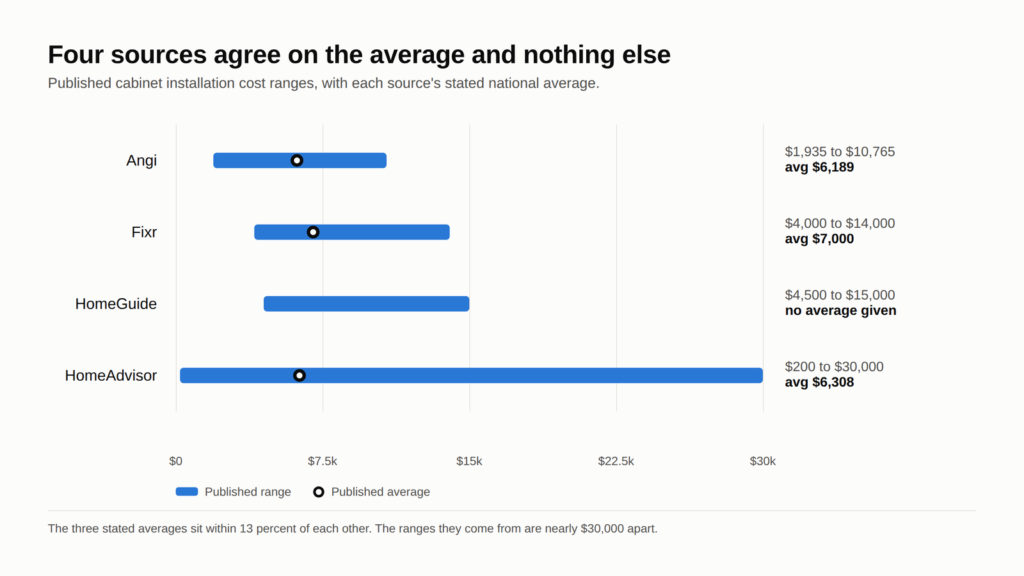
Three of the biggest cost websites in the country publish an average cabinet installation cost within a few hundred dollars of each other. Angi says $6,189. HomeAdvisor says $6,308. Fixr says $7,000.
Then look at the ranges those same sites publish. Angi says $1,935 to $10,765. Fixr says $4,000 to $14,000. HomeAdvisor says $200 to $30,000.
The averages agree. The ranges are nearly $30,000 apart. And the range is the part that actually decides what you pay.
This guide works through where each figure comes from, which ones hold up, and which ones fall apart when you look closely. By the end you’ll be able to count the cabinets in your own kitchen and put a real number on the job.
Cabinet installation cost, the short answer
For a standard kitchen of 20 to 30 linear feet, expect $6,000 to $12,000 installed with mid-range cabinets.
A small kitchen of 10 to 15 linear feet runs $3,000 to $6,000. A large or custom kitchen of 35 linear feet and up starts around $12,000 and has no real ceiling. Angi puts the top of that bracket at $25,000 in one table and says large kitchens “can exceed $30,000” a few paragraphs earlier, which tells you how soft the high end is.
A bathroom vanity is a different animal. Three to eight linear feet, $1,000 to $5,000 for the cabinet and the install together.
Those brackets are more useful than any national average cabinet installation cost, because the average is pulled around by whether the sample included people buying $150 stock boxes or $2,000 custom ones. Those are not the same purchase.
Why the price per linear foot confuses almost everyone
Every cost site quotes cabinets by the linear foot. Almost none of them say what’s inside the number.
Angi publishes a total range of $100 to $1,200 per linear foot. On a different part of the same page it publishes labor at $100 to $300 per linear foot. Those are two completely different things, and the page never separates them clearly. Fixr quotes labor at $50 to $200 per linear foot. HomeGuide quotes $150 to $700 per linear foot without saying whether cabinets are included.
So when a contractor tells you “$300 a foot,” you still don’t know what you’ve been told.
Ask one question and the confusion goes away. Does that price include the cabinets, or is it labor only? A 25-foot kitchen at $300 a foot is $7,500 if that covers everything, and $7,500 on top of a $10,000 cabinet order if it doesn’t. Same sentence, $10,000 apart.
What cabinet installation costs per cabinet
Installers don’t really think in linear feet. They think in boxes.
A wall cabinet runs $150 to $1,200 supplied and fitted. A base cabinet runs $200 to $2,000, because it’s bigger, heavier and usually has to accommodate plumbing or appliances. Specialty units like pantries, corner carousels and island bases run $500 to $5,000.
Labor on its own is far simpler. A handyman charges roughly $55 to $85 per cabinet. A cabinet specialist charges $100 to $300 per box. Hourly rates run $40 to $100 at the low end and $50 to $250 at the high end depending on who you ask and where you live.
This is the most useful way to estimate your own job. Walk into your kitchen and count the boxes. Most standard kitchens have somewhere between 15 and 25. Multiply by $150 for labor and you have a realistic middle-of-the-road installation figure before a single cabinet is bought.
The labor percentage rule that falls apart
Here’s where the published advice goes wrong.
Fixr says labor is 30 to 50 percent of a cabinet job. Angi says materials are 25 to 50 percent, which puts labor at 50 to 75 percent. Those two claims can’t both be true, and neither matches what real invoices show.
HomeLight published an actual itemized job from a cabinet company in Prescott, Arizona. Thirteen semi-custom cabinets. Materials $10,150. Labor $950. Hardware $400. Delivery $300. Total $11,800.
Labor on that job was eight percent.
The rules of thumb aren’t wrong by accident. They’re wrong because labor is roughly fixed per cabinet while materials are not. Hanging a $200 stock box takes the same two hours as hanging a $1,800 custom one.
Run it both ways on a 20-cabinet kitchen with labor at $200 a box, so $4,000 either way.
With stock cabinets at $150 each, materials are $3,000 and labor is 57 percent of the job.
With custom cabinets at $900 each, materials are $18,000 and labor is 18 percent.
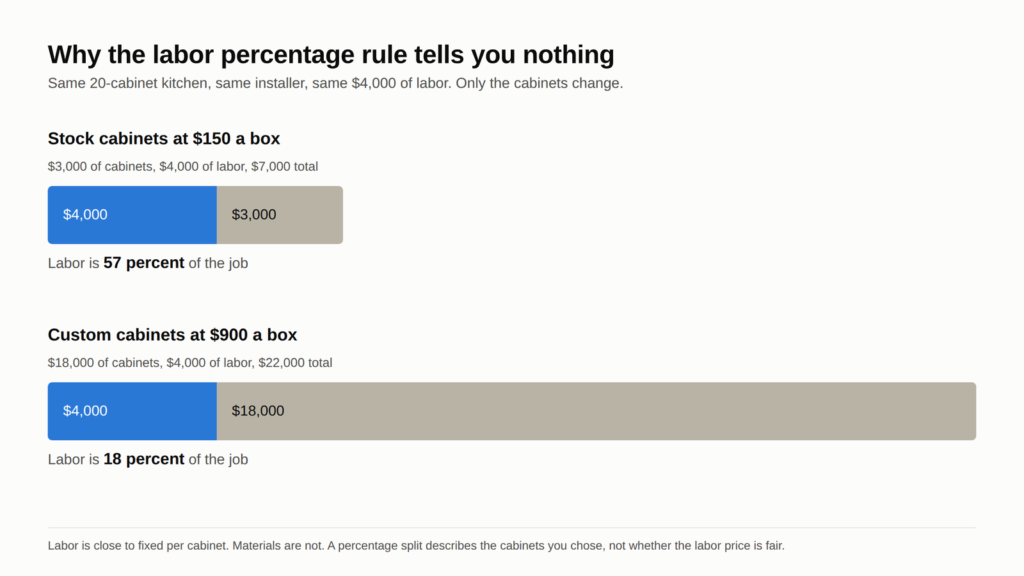
Same installer, same hours, same kitchen. The percentage swung by 39 points and told you nothing about either job.
So when a quote arrives, ignore the percentage split entirely. Look at the labor number per cabinet and ask whether it’s reasonable. That number you can actually judge.
How to read a cabinet quote before you sign it
Most disputes on a cabinet job come from a quote that was vague in one specific place, and it’s almost always the same place.
Check whether the quote separates cabinets from labor. If it’s one lump sum, ask for the split. Not because you’re going to argue about it, but because you can’t compare two quotes that are built differently, and you can’t tell whether the second contractor is cheaper on labor or just quoting lower-grade boxes.
Check what happens to the old cabinets. Removal and disposal is $350 to $1,000 and it either sits in the quote or it doesn’t. If it’s absent, assume it’s yours.
Check whether hardware is included. On a 20-cabinet kitchen this is a four-figure line item at the top end, and it’s the single most common thing left out.
Check the countertop. If your new base cabinets are a different height or depth, the existing top will not go back on. The quote should say in writing whether a new template and refit is included or excluded.
Check who pulls the permit, if one is needed, and whether the fee is in the price.
Ask what happens if the walls aren’t flat. Every installer deals with this constantly. Scribing, filler strips and packing out a bowed wall are normal work, but on a tight quote they turn into a change order. A contractor who answers that question with a shrug is telling you something.
Get at least three quotes and read them side by side. On a job with this much variation between suppliers, the spread between the cheapest and the dearest quote on the same kitchen is routinely 40 percent.
Kitchen cabinets and bathroom cabinets are priced differently
A kitchen is 20 to 30 linear feet of cabinetry. A bathroom vanity is three to eight. You’d expect bathroom costs to be a straight fraction of kitchen costs, and they’re not, because the plumbing changes everything.
Angi puts bathroom vanity installation at $400 to $2,200 with a national average of $1,500 including the unit itself. Labor alone is $200 to $1,000. A prefabricated vanity costs $300 to $1,500, a custom one $400 to $3,000.
Then on the same page, Angi lists plumbing work for a vanity install at $400 to $2,200, average $1,500.
Read those two figures together. The plumbing alone averages exactly what the entire project averages, unit included. One of those numbers is wrong, and there’s no way to tell which from the page.
What’s actually true is that a vanity swap in the same footprint, reusing the existing supply and waste lines, is a half-day job in the $400 to $900 range for labor. Move the vanity to a different wall and you’re into the same floor-opening, pipe-rerouting territory that drives small bathroom remodel cost into five figures.
Stock, semi-custom or custom
Stock cabinets run $100 to $300 per linear foot installed. Semi-custom run $200 to $650. Custom run $500 to $1,200.
Fixr prints that custom top figure as $1,200 in its table and $1,230 in the body text of the same article. A small thing, but it shows how much of this data is copied around rather than checked.
A larger example of the same problem. HomeLight republished a HomeAdvisor figure for high-end custom cabinets as “$13,000 to $30,000 per linear foot.” At that rate a 25-foot kitchen would cost $325,000 at the bottom end. It’s obviously a project total that lost its label somewhere in the chain, and it’s sitting on a major real estate website being read as a per-foot price.
This is why a single number from a single site is worth very little. The figure gets copied, the unit gets dropped, and three sites later it’s presented as fact.
Custom genuinely earns its price in two situations. Old houses where nothing is square and standard boxes leave ugly gaps. And kitchens with an awkward dimension, like a nine-foot ceiling where stock wall cabinets leave a dead strip of wall that collects dust for twenty years.
Everywhere else, semi-custom gets you most of the way for roughly half the money.
What your location does to the price
Regional differences in cabinet installation cost are real but smaller than people expect.
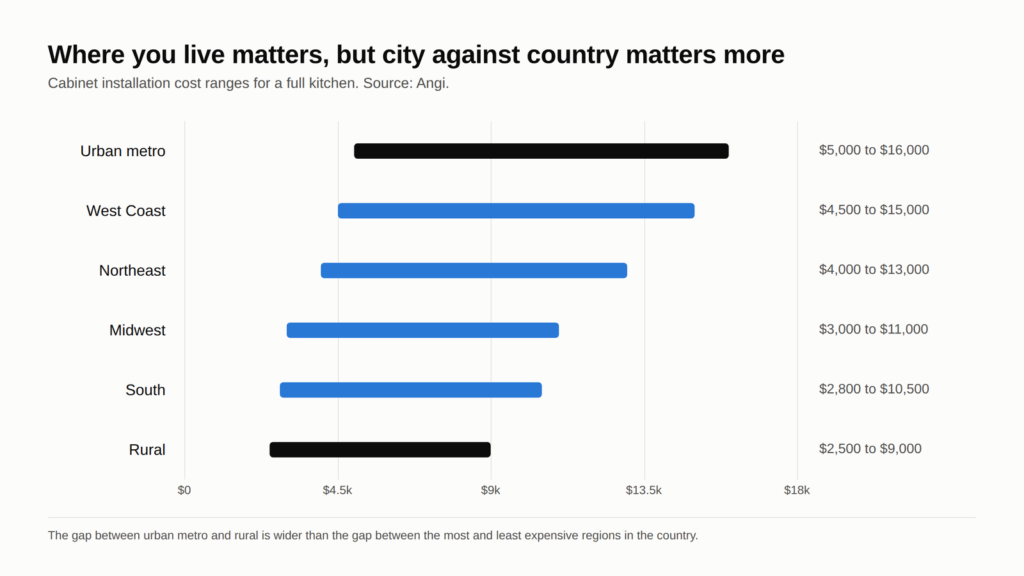
The West Coast runs $4,500 to $15,000. The Northeast runs $4,000 to $13,000. The Midwest runs $3,000 to $11,000. The South runs $2,800 to $10,500.
The bigger split isn’t regional at all. It’s urban against rural. Urban metro areas run $5,000 to $16,000. Rural areas run $2,500 to $9,000. That’s a wider gap than between the most and least expensive regions in the country.
If you live an hour outside a major metro, it’s worth getting a quote from an installer based in the smaller town rather than the city. The drive gets added as a trip charge, and it’s usually still cheaper.
The costs that don’t make it into the headline number
Removal and disposal of your old cabinets costs $350 to $1,000. Angi puts it at $350 to $800, Fixr at $350 to $1,000. Doing the demolition yourself saves up to $1,000, and it’s genuinely a job most people can handle with a screwdriver and a pry bar.
Permits cost $50 to $400. Angi quotes $150 to $400 in one section and $50 to $400 in another, so budget toward the higher end.
Delivery trip charges show up on real invoices and almost never on cost guides. The Prescott job had $300 of delivery on an $11,800 project.
Hardware is the one people underestimate most. Knobs and pulls run $2 to $50 each. On a 20-cabinet kitchen with 30 handles that’s $60 at the cheap end and $1,500 at the expensive end. Then there’s labor to fit them. On that Prescott invoice, $150 of hardware carried $250 of labor.
Crown molding adds $4 to $23 per linear foot. Electrical work runs $50 to $130 an hour and plumbing $45 to $200 an hour, both of which get triggered the moment a cabinet lands where an outlet or a pipe currently is.
And the one nobody warns you about. If your new base cabinets are a different height than the old ones, your countertop has to be re-templated and refitted. On stone that’s not an adjustment, it’s a new countertop.
The label on the back of the cabinet
This is the part of a cabinet purchase that gets skipped, and it matters more than the door style.
Kitchen and bathroom cabinets are mostly built from hardwood plywood, MDF and particleboard. All three are covered by the federal formaldehyde emission standards under TSCA Title VI, enforced by the US Environmental Protection Agency.
Finished goods manufactured or imported after March 22, 2019 have to carry a label showing the fabricator’s name, the production month and year, and a TSCA Title VI compliance statement. Panels carry a slightly different label that includes the producer’s name, a lot number and the certifier’s number.
If you’re buying a deal that seems well under the market, look for that label before anything else. Cabinets are a large area of engineered wood sitting in a room your family uses every day, and the standard exists for a reason. A compliant cabinet costs essentially the same as a non-compliant one from a legitimate supplier, so there’s nothing to gain by skipping the check.
Should you install cabinets yourself?
DIY installation saves 30 to 50 percent of the labor cost. A full DIY kitchen including tools, hardware, materials and delivery runs $1,500 to $4,000.
Base cabinets are forgiving. They sit on the floor, they get shimmed level, and small errors hide behind toe kicks and countertops.
Wall cabinets are where DIY jobs go wrong. They have to be dead level across a run, fixed into studs that aren’t always where you need them, and hung at a consistent height while you’re holding 60 pounds overhead. Walls are rarely plumb, so the gap at the back has to be scribed and filled. A run that’s half an inch out across eight feet looks fine until the doors are on, and then every gap is wrong.
The honest split is this. If you’re replacing cabinets in the same layout and you’re comfortable with a level, a stud finder and a helper, base cabinets are a reasonable weekend. Get a professional for the wall run, or at least for the first cabinet, because everything else lines up off that one.
Does it pay you back at resale?
The Journal of Light Construction’s 2025 Cost vs Value report puts a minor kitchen remodel at up to 113 percent return on investment.
Treat that figure carefully. “Up to” is doing a lot of work, and a minor kitchen remodel in that report means refacing or replacing cabinet fronts, not tearing out the whole run and starting again. A full custom cabinet replacement does not return 113 percent.
Refacing or painting costs about 50 percent less than new cabinets. Paint plus new hardware can refresh a dated kitchen for under $2,000, and on a house you’re selling in the next year that’s usually the better financial move by a wide margin.
If you’re staying put for a decade, buy what you actually want. The return on a kitchen you enjoy using every day isn’t measured in the Cost vs Value report.
Frequently asked questions
How much does it cost to install kitchen cabinets?
A standard 20 to 30 linear foot kitchen costs $6,000 to $12,000 for cabinets and installation combined. Labor alone is roughly $100 to $300 per cabinet, so a 20-cabinet kitchen runs $2,000 to $6,000 in labor before the cabinets themselves.
How much does it cost to install bathroom cabinets?
A bathroom vanity costs $1,000 to $5,000 including the unit. Labor on its own is $200 to $1,000. A straight swap in the same position, reusing the existing plumbing, sits at the bottom of that range.
How much is labor to install cabinets per cabinet?
A handyman charges $55 to $85 per cabinet. A cabinet specialist charges $100 to $300. The specialist is worth it on a full kitchen where everything has to line up, and overkill for hanging two boxes in a laundry room.
How long does cabinet installation take?
A full kitchen takes two to four days for a two-person crew, not counting the countertop, which gets templated after the base cabinets are in and fitted a week or two later. A single vanity is a half day.
Is it cheaper to reface or replace cabinets?
Refacing costs around half of replacement and is the better choice when the carcasses are sound and you only dislike the doors. If the boxes are water damaged, sagging or the layout doesn’t work, refacing spends real money without fixing the actual problem.
Do I need a permit to install cabinets?
Swapping cabinets in the same layout usually doesn’t need one. Moving plumbing or electrical does. Permits cost $50 to $400 depending on your municipality, and your contractor normally pulls it for you.
Putting a number on your own kitchen
Count the boxes. Wall cabinets, base cabinets, and any specialty units separately.
Multiply the total by $150 for a mid-range labor estimate, or $250 if you’re in an urban metro.
Add the cabinets themselves. Stock at $150 to $400 a box, semi-custom at $400 to $900, custom at $900 and up.
Add removal at $350 to $1,000, hardware at roughly $25 a handle fitted, and delivery at $200 to $400.
Then hold back 10 to 15 percent. On a cabinet job the surprises are usually a wall that isn’t flat, a floor that drops an inch across the run, or an outlet in exactly the wrong place. All three are fixable, none are free.
That gives you a cabinet installation cost built from your own kitchen rather than a national average that was never about your house.
