Concrete cost per yard is one of those numbers that looks simple until you actually phone a supplier. The quote you get back depends less on the concrete itself than on how much of it you are ordering, how far the truck has to drive, and how long you keep the driver waiting. Two neighbors pouring identical slabs a month apart can pay very different amounts for the same material.
This guide breaks down what you are really paying for, where the hidden charges sit, and the one decision that matters most on a small job: whether to order a truck at all.
What a Yard of Concrete Costs Delivered
For a standard mix delivered within about 20 miles, expect roughly $119 to $147 per cubic yard. That figure assumes a full truckload, which is around 10 cubic yards.
A cubic yard is 27 cubic feet, and it is a lot more material than most people picture. One yard covers about 80 square feet at 4 inches thick. A full truck covers around 800 square feet at the same thickness, which is a decent sized driveway.
That range is for ordinary residential mix. Higher strength concrete, fiber reinforcement, color and special finishes all push it up, and we cover those further down.
The Short Load Fee Is What Catches People Out
Here is the part that surprises almost every homeowner ordering concrete for the first time. Ready-mix trucks are batched in full loads of around 10 cubic yards. If you order less than that, the supplier still has to send a truck, clean it out and write it off for the trip, so they charge you for the privilege.
The short load fee runs about $53 per cubic yard on anything under 10 yards, which takes your effective rate to roughly $172 a yard. Short-load specialists who mix on site charge differently again, on a sliding scale that gets cheaper per yard the more you take:
| Volume ordered | On-site mixing fee |
|---|---|
| 1 to 1.75 cubic yards | $110 |
| 2 to 2.75 cubic yards | $100 |
| 3 to 3.75 cubic yards | $90 |
| 4 to 4.75 cubic yards | $80 |
| 5 to 5.75 cubic yards | $70 |
| 6 to 6.75 cubic yards | $60 |
The practical effect is that small orders are punished hard. One cubic yard delivered costs about $310 all in, which works out at $310 a yard. Ten cubic yards costs about $1,470, which is $147 a yard. The same material, less than half the price, purely because of volume.
If you are close to a round number, it is often worth stretching the job. Going from 9 yards to 10 can cost you nothing extra and sometimes less.
Bags or a Truck? The Crossover Is Under One Yard
Everyone assumes bags are the cheap option for a small job. They are, but only for a much smaller job than most people think.
A 50 pound bag of concrete mix runs about $4.49 and yields 0.014 cubic yards, so it takes roughly 71 bags to make a single cubic yard, costing around $321. That is already more than the $310 a delivered yard costs once short load fees are counted.
Run it across a few volumes and the picture is clear:
| Volume | Bags | Delivered | Cheaper option |
|---|---|---|---|
| 0.25 cubic yards | $80 | $160 | Bags |
| 0.5 cubic yards | $160 | $210 | Bags |
| 0.75 cubic yards | $240 | $260 | Bags, just |
| 1 cubic yard | $321 | $310 | Truck |
| 2 cubic yards | $641 | $500 | Truck |
| 5 cubic yards | $1,603 | $1,070 | Truck |
The crossover sits at roughly 0.8 cubic yards, which is about 65 square feet at 4 inches thick. Below that, bags win. Above it, the truck wins and the gap widens fast. By 5 yards you are paying half as much again for the privilege of mixing it yourself.
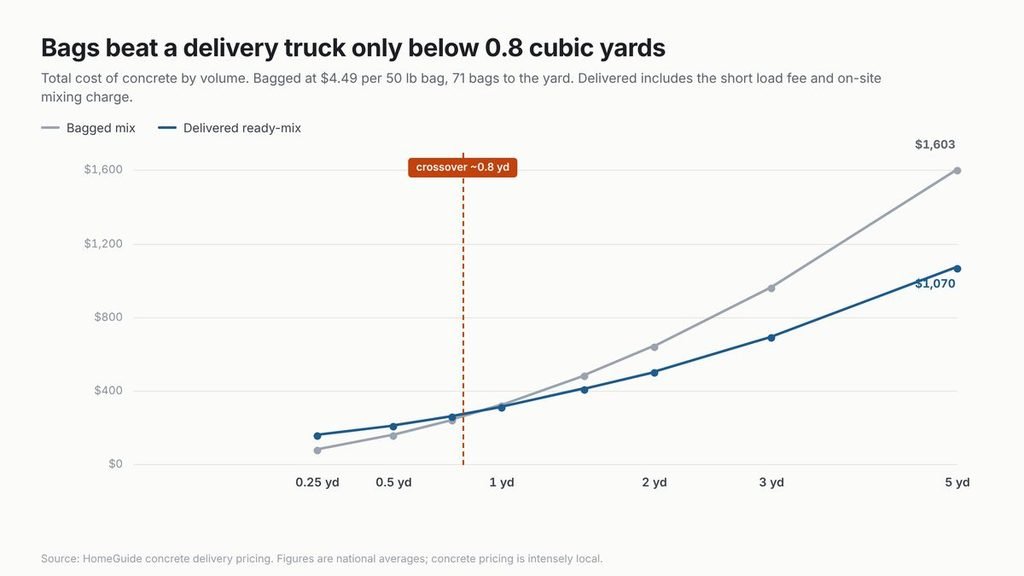
And that comparison ignores labor entirely. Seventy one bags is roughly 3,550 pounds of material to carry, open, mix and place, and concrete does not wait for you. For anything beyond a few post holes or a small pad, the truck is not just cheaper, it is the only realistic option.
How Much Concrete Do You Actually Need
The arithmetic is simple and worth doing yourself before anyone quotes you.
Multiply length in feet by width in feet by thickness in feet, then divide by 27. Thickness in inches becomes feet by dividing by 12, so 4 inches is 0.333 feet.
A 10 by 10 pad at 4 inches: 10 × 10 × 0.333 = 33.3 cubic feet, divided by 27 = 1.23 cubic yards.
A 20 by 20 patio at 4 inches: 20 × 20 × 0.333 = 133.3 cubic feet, divided by 27 = 4.94 cubic yards.
A 24 by 24 garage floor at 6 inches: 24 × 24 × 0.5 = 288 cubic feet, divided by 27 = 10.67 cubic yards.
Then add 10 percent. Ground is never perfectly level, forms bow slightly, and running short halfway through a pour is a genuinely expensive mistake because the first batch starts curing while you wait for more. Ten percent on that 10 by 10 pad takes you to 1.36 yards, so you order 1.5.
Notice what happens with the garage floor. At 10.67 yards plus waste you are at 11.7, which means two trucks or one truck plus a short load. That is exactly the point where it is worth asking whether 5 inches would do, because dropping to 5 inches brings you to 8.9 yards and one delivery.
What a Finished Slab Costs Per Square Foot
Concrete cost per yard is only the material. If you are hiring someone to do the whole job, the number you actually want is cost per square foot installed, which runs $6 to $12. Of that, materials are $3 to $7 and labor is $3 to $5.
Thickness moves it. A 4 inch slab runs $6 to $8 per square foot installed, and a 6 inch slab $8 to $10. Most residential slabs are 4 to 6 inches, garage floors are reinforced at 4 to 6, and house foundations are usually 6.
By size, that gives you:
| Slab | Square feet | Installed cost |
|---|---|---|
| 10 x 10 pad | 100 | $600 to $1,200 |
| 20 x 20 patio | 400 | $2,400 to $4,800 |
| Two car garage floor | 400 to 576 | $2,400 to $6,900 |
If you are pricing a renovation that involves more than concrete, our guides to small bathroom remodel cost and storm door installation cost break down other jobs the same way.
The Charges That Are Not in the Headline Quote
Ask about these specifically, because they rarely appear until the invoice does.
Standby time is the one that stings. Most suppliers allow a few minutes of unloading time and then charge roughly $3 per minute beyond it. An unprepared site, forms that are not finished or not enough people to move the concrete can turn into a hundred dollars of waiting in half an hour.
Distance beyond the included radius costs around $9.50 per mile past about 20 miles. Rural deliveries add up quickly.
Saturday delivery adds roughly $8 per cubic yard.
Pumping, if the truck cannot reach the pour, runs about $15 per cubic yard for a trailer pump with a $125 minimum, or $140 to $190 an hour for a boom truck. Back gardens with no vehicle access are the usual reason.
Color is expensive, at $31 to $170 per cubic yard plus around $96 for cleaning the truck out afterward. Special finishes add about $96 per load.
Before the Truck Arrives
Standby charges are the one cost on this page that is entirely within your control, and the way to avoid them is to be genuinely ready before the truck turns into your driveway rather than nearly ready.
Forms should be built, braced and checked for level the day before, not the morning of. Concrete is heavy enough to push a poorly braced form out of line, and once it does there is no undoing it. The sub base wants to be compacted and damp rather than dry, because dry ground pulls water out of the mix from underneath and weakens the bottom of the slab. If you are building that sub base from scratch, our gravel calculator will size the stone for it.
Work out where the truck will park and whether the chute reaches. A standard chute gives you around 10 to 12 feet from the back of the truck. Beyond that you are moving concrete by wheelbarrow, which needs a clear run and more people than you think, or paying for a pump.
Have your tools out and your crew standing there before the delivery window opens. Screed, bull float, edger, groover, gloves and boots. Once the concrete starts moving you have a limited working time, and in hot weather that window shrinks considerably. If you have not screeded and floated a slab before, the American Cement Association’s guide to working with concrete walks through the order those steps go in.
One last thing worth asking when you book: what the supplier’s washout policy is. Some expect you to provide somewhere on site for the chute to be rinsed, and a bucket of concrete slurry on your lawn is a poor end to the day.
What Moves the Concrete Cost Per Yard
Volume, by a distance. It is the single biggest influence on concrete cost per yard and it is the one you can sometimes control by combining jobs.
Strength. Concrete is specified in PSI. A 3,000 PSI mix suits patios and walkways, 4,000 PSI is usual for driveways and garage floors carrying vehicle loads, and higher grades cost more per yard. Do not let anyone talk you into 5,000 PSI for a garden path. Those strength grades come from the building code standards published by the American Concrete Institute, which is also what your local inspector will be working from.
Location. Concrete is heavy and cannot travel far economically, so pricing is intensely local. Two suppliers 30 miles apart can quote very differently, and it is always worth getting three quotes. The USGS tracks cement supply and demand nationally, which is the pressure sitting behind whatever your local plant quotes you.
Season. Spring and summer are peak. Cold weather pours may need additives or blankets, and hot weather pours need retarders, both of which add cost.
Reinforcement. Rebar or wire mesh is usually a separate line, and for anything load bearing it is not optional.
Frequently Asked Questions
How much is a yard of concrete?
About $119 to $147 delivered if you are taking a full 10 yard load. On a small order, short load fees push the effective concrete cost per yard to around $172, and a single yard delivered lands near $310 once mixing fees are included.
How many bags of concrete make a cubic yard?
Roughly 71 bags at 50 pounds each, since one bag yields about 0.014 cubic yards. That is around 3,550 pounds of material to move by hand.
How much area does a yard of concrete cover?
About 80 square feet at 4 inches thick, 65 square feet at 5 inches, or 54 square feet at 6 inches.
Is it cheaper to mix my own concrete?
Only below about 0.8 cubic yards, which is roughly a 65 square foot pad at 4 inches. Beyond that, delivery is cheaper even after short load fees, and the labor difference is enormous.
Why is there a minimum order?
A ready-mix truck has to be loaded, driven, unloaded and washed out whether it carries one yard or ten. The short load fee covers the cost of a trip that is not paying for itself.
How much extra should I order?
Ten percent. Running short mid-pour means the first concrete starts curing before the rest arrives, which creates a cold joint and a weak point. Having a little left over is far cheaper than that.
What thickness do I need?
Four inches covers patios, walkways and sheds. Five to six inches is normal for driveways and garage floors carrying vehicles. Going thicker than you need is expensive, since every extra inch across a 400 square foot slab adds over a cubic yard.
Do these prices include labor?
No. Concrete cost per yard is the material delivered to your driveway. A finished slab poured and troweled by a contractor runs $6 to $12 per square foot including both materials and labor.
