If you check three websites about small bathroom remodel cost, you’ll get three different answers. This isn’t because someone is lying.
It’s because the term “small bathroom” covers everything from a 15 square foot powder room to a 40 square foot primary bathroom. And a remodel that keeps the existing plumbing costs far less than one that moves the pipes.
So this guide does something most cost articles don’t. It gives you the figures, tells you where each one came from, and is honest about where the sources disagree. By the end you’ll be able to look at your own bathroom and put a realistic number on it, instead of carrying around a national average that may have nothing to do with your project.
Small bathroom remodel cost, the short answer
For a small full bathroom of around 30 square feet, expect somewhere between $4,500 and $16,800.
That range comes from two independent sources that happen to agree on the bottom end. Angi puts a small full bathroom at $4,500 to $6,000, and gives $6,500 as the national average across all small bathroom projects. BuildCost puts the same 30 square foot room at $4,500 at the low end, $8,940 in the middle and $16,800 at the high end.
Notice the gap at the top. Angi’s range tops out around $6,000, while BuildCost sees projects reaching $16,800 for the same floor area. Both are correct. Angi is describing a straightforward refresh. BuildCost is including projects where someone gutted the room, moved the plumbing and chose expensive tile.
Here’s the most important thing to understand before you start. The size of the room sets the floor of your budget. Your choices set the ceiling.
Small bathroom remodel cost by size
Square footage is the first thing a contractor asks about, because almost every material cost scales with it.
A half bath or powder room, roughly 15 square feet, runs $2,250 to $3,000 according to Angi. There’s no shower or tub, so you’re paying for a toilet, a small vanity, flooring, paint and the labor to fit them.
A small full bathroom, roughly 30 square feet, runs $4,500 to $6,000 on Angi’s figures. This is the standard 5 by 6 foot bathroom found in millions of American homes. Toilet, vanity, tub or shower, flooring.
A small primary bathroom, roughly 40 square feet, runs $6,000 to $8,000. The extra space usually means a bigger vanity, sometimes a separate shower, and more tile.
Converting a half bath into a full bathroom is its own category and costs $2,800 to $10,000, with Angi noting $7,200 as a realistic minimum once you’re adding a basic tub. You’re adding drainage, waterproofing and ventilation that weren’t there before, which is why it costs more than the square footage alone suggests.
A note on cost per square foot, since you’ll see it quoted everywhere. BuildCost’s own tables work out to roughly $150 per square foot at the low end and $560 at the high end, and those rates stay flat across every size band on their site, even though the same page says larger projects should cost less per unit. Treat per square foot figures as a rough sanity check, not a quoting method. No contractor prices a bathroom that way.
Where does the money actually go?
Labor is the biggest single line, and it surprises people.
Angi puts labor at 40 to 60 percent of a small bathroom budget. BuildCost breaks a typical bathroom into $8,761 labor against $9,119 materials, which is a 49 to 51 split. So on a $6,000 bathroom, somewhere between $2,400 and $3,600 of it is paying people, not buying things.
That ratio matters because it explains why cutting material costs has less effect than people expect. Choosing a $200 vanity instead of a $600 one saves you $400. Changing the layout so the plumber works an extra two days costs you more than that.
Here’s what the individual pieces run, using Angi’s 2026 material figures.
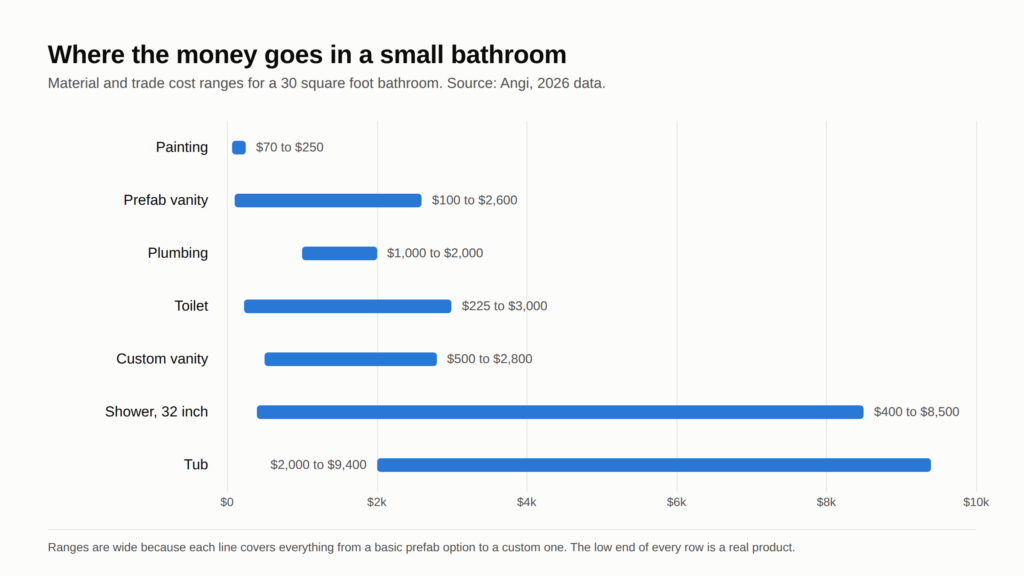
A prefabricated vanity costs $100 to $2,600. Angi’s own article quotes $300 as a typical prefab figure in the text while its table starts at $100, so budget around $300 to $500 for something you won’t resent in two years.
A made to order vanity runs $500 to $2,800 in the table and up to $3,800 in the text. This is the line item where small bathrooms most often blow their budget, because a custom vanity is the obvious answer to an awkward space.
A vanity is a cabinet, and it’s priced like one. Our guide to cabinet installation cost covers what you pay for the unit against what you pay to fit it.
A toilet costs $225 to $3,000. The vast majority of homeowners spend near the bottom of that. The top end is electric and motorized and not something a small bathroom needs.
A standard 32 inch shower costs $400 to $8,500. That range is enormous because it covers everything from a prefab acrylic insert to a fully tiled custom enclosure. The acrylic insert is the budget option and it’s not a bad one for a small room.
A tub costs $2,000 to $9,400. If your existing tub is sound, refinishing it costs under $650 and is the single highest leverage saving available on this list.
Flooring materials run from under a dollar to $90 per square foot depending on what you pick. Basic vinyl installed is $2 to $7 per square foot. Porcelain tile is $0.50 to $15. Stone is $6 to $20. On a 30 square foot bathroom the difference between vinyl and stone is a few hundred dollars, which makes flooring one of the cheaper places to upgrade.
Painting a small bathroom costs $70 to $250. It’s the best value change in the room and it’s the one most people do themselves.
The decision that changes your small bathroom remodel cost most
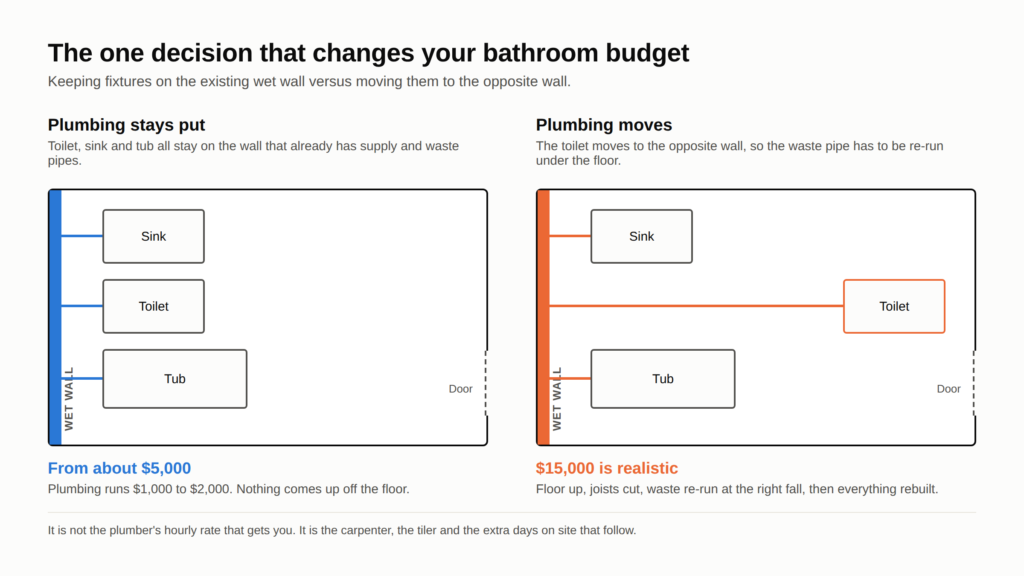
If you remember one thing from this article, make it this. Moving the plumbing is what separates a $5,000 bathroom from a $15,000 one.
Angi puts plumbing at $1,000 to $2,000 for a typical small bathroom project and plumber rates at $45 to $200 an hour. Those numbers assume the toilet, sink and shower stay roughly where they are.
The moment you move a drain you’re into the floor. That means pulling up flooring, cutting into joists in some cases, re-running waste pipe at the correct fall, and then rebuilding everything you opened up. It isn’t the plumber’s hourly rate that gets you. It’s the carpenter, the tiler and the extra days on site that follow.
So when a designer shows you a layout with the toilet on the opposite wall, ask what that single change adds. In a small bathroom it’s frequently the difference between the project you planned and the project you can afford.
The flip side is genuinely good news. If you keep the layout, a small bathroom remodel is one of the more predictable jobs in home improvement. Angi suggests $5,000 is a realistic budget for a remodel that keeps the layout and avoids luxury fittings, and that matches the low ends of both sources.
What your location does to the price
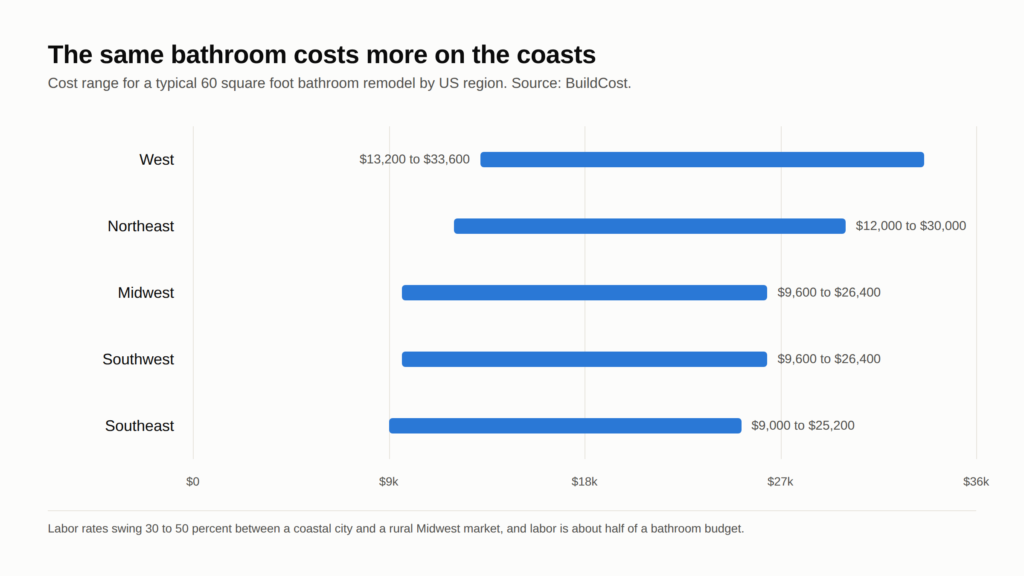
Regional labor rates move the total more than most people expect, and since labor is around half the budget, the effect is large.
BuildCost’s regional figures for a typical bathroom show the Northeast at $12,000 to $30,000 and the West at $13,200 to $33,600, against the Southeast at $9,000 to $25,200. The Midwest and Southwest sit between the two at $9,600 to $26,400.
That’s roughly a 30 to 50 percent swing in labor rates between a coastal city and a rural Midwest market, which BuildCost states directly.
Scale those proportions down to a small bathroom and the practical effect is simple. The same 30 square foot bathroom that costs $5,000 in rural Ohio can cost $7,000 or more in Boston or San Francisco, with identical materials. If you’re using a national average to budget, adjust it for where you live before you do anything else.
The costs people forget
Bathrooms tend to go over budget in the same few places, and none of them are the fixtures.
Permits cost $100 to $1,000 depending on your municipality, and you’ll generally need one if you’re changing plumbing or electrical. Angi’s own page quotes both $100 and $150 as the starting figure, so call your local building department rather than relying on any published range.
A dumpster rental for the demolition runs $240 to $650 for a 15 cubic yard container. Small bathrooms produce more waste than people expect once the tile and the old tub are out.
Electrical work runs $50 to $100 an hour. Older bathrooms frequently need a GFCI outlet added, a new light circuit, or an extractor fan that was never there.
Asbestos tile removal, if you have it, costs $5 to $20 per square foot. In houses built before the 1980s this is a real possibility and it’s worth testing before demolition rather than discovering it mid project.
An architect costs $125 to $250 an hour and an interior designer $50 to $200 an hour. Most small bathrooms need neither. A structural engineer at $345 to $800 is only relevant if you’re moving a wall.
The pattern across all of these is that they aren’t optional extras. They’re things a thorough quote includes and a cheap quote leaves out. When one bid comes in well under the others, this list is usually where the difference is hiding.
Where to save without regretting it
Not all savings are equal. Some you notice every day and some you never think about again.
Keep the layout. This is worth more than every other saving on this list combined, for the reasons above.
Refinish the tub instead of replacing it. Under $650 against $2,000 to $9,400 for a new one, and if the existing tub is structurally sound the result is genuinely good.
Choose a prefab vanity over custom. The gap is $300 against $3,800 at the extremes. In a small bathroom a well chosen prefab unit in the right size looks deliberate, not cheap.
Use a prefab shower insert rather than a tiled enclosure. The low end of the shower range is $400 against $8,500 for custom tile work, and an insert has no grout to maintain.
Do the painting yourself. $70 to $250 of materials against paying someone, and it’s the one job in a bathroom that’s genuinely low risk for a beginner.
Where not to save: fixtures you touch every day, waterproofing behind tile, and ventilation. A cheap extractor fan in a small bathroom with no window leads to mold, and mold costs far more to fix than the fan saved.
If you are working with a tight footprint, our guide to small bathroom remodel ideas covers the layout and storage tricks that make a small room feel larger without adding to the budget.
One upgrade that pays for itself quietly is choosing WaterSense labeled fixtures. According to the US Environmental Protection Agency, WaterSense labeled bathroom faucets have a maximum flow of 1.5 gallons per minute against 2.2 for a standard faucet, a reduction of 30 percent or more. The EPA estimates the average family saves around 700 gallons of water a year by replacing old faucets and aerators, and nearly 11,000 gallons over the lifetime of the faucet. On a small bathroom remodel the labeled fixture usually costs the same as the unlabeled one, so there’s no reason not to.
How long a small bathroom remodel takes
Most small bathroom remodels run two to three weeks from demolition to finish, assuming the layout stays put and materials are on site before work begins.
The sequence matters more than the total. Demolition takes a day or two. Rough plumbing and electrical take two to four days. Waterproofing and tile take the longest stretch, often a week, because tile and grout need curing time between stages. Fixtures, vanity and painting take the final few days.
Angi notes contractors charge $300 to $500 a day where they bill by the day, though most quote a flat project price for bathrooms. If you’re given a daily rate, the timeline above tells you roughly what to expect the total to be.
The two things that stretch a timeline are moving plumbing, which adds days of structural work, and ordering materials late. Tile in particular has lead times, and a bathroom sitting half finished while a delivery arrives is the most common reason a two week job becomes a five week job.
Is a small bathroom remodel worth it at resale?
Bathrooms recoup more than most rooms, but less than the internet suggests.
Angi gives an average return on investment of 55 to 60 percent for a bathroom remodel in one section of its page and 70 percent in its FAQ, which is a good illustration of why you shouldn’t treat any single ROI figure as gospel.
Cost versus value data published by the Journal of Light Construction and reported by Zillow puts a midrange bathroom remodel at a national average of $26,138 with about $20,915 recouped at resale, which works out at roughly 80 percent.
Two things about that 80 percent. It’s for a midrange full bathroom remodel, not a small one, so don’t apply it directly to your 30 square foot project. And recouping 80 percent still means losing 20 percent, so a remodel done purely as an investment rarely makes sense on its own.
The honest framing is this. A small bathroom remodel is worth doing if you’re going to live with it, and the resale value softens the cost. It’s worth doing before a sale only if the existing bathroom is actively putting buyers off, which is a different calculation entirely.
Frequently asked questions
What is a realistic small bathroom remodel cost if I keep the layout?
Around $5,000. That figure comes from Angi and it lines up with the low end of BuildCost’s range for a 30 square foot room. It assumes standard fittings, no plumbing relocation and no structural surprises.
Can I remodel a small bathroom for $3,000?
For a full bathroom, that’s tight but not impossible if you refinish rather than replace the tub, keep the existing vanity or buy a basic prefab, lay vinyl flooring and do the painting and some demolition yourself. For a half bath at around 15 square feet, $3,000 is comfortably within Angi’s $2,250 to $3,000 range.
Why do quotes vary so much for the same bathroom?
Three reasons, in order of size. Whether the quote includes moving plumbing. Where you live, since labor rates swing 30 to 50 percent regionally. And whether the quote includes the forgettable costs like permits, the dumpster and electrical work, which is usually where a suspiciously cheap bid is hiding its margin.
Do I need a permit to remodel a small bathroom?
Usually yes if you’re altering plumbing or electrical, and usually no for a cosmetic refresh like paint, a new vanity top and fixtures in the same positions. Permits cost $100 to $1,000 depending on your area. Your local building department is the only reliable answer, and the call is free.
Is it cheaper to remodel a bathroom or add one?
Remodeling, substantially. Angi puts converting a half bath to a full bath at $2,800 to $10,000 with $7,200 as a realistic minimum once a tub is involved, and adding a bathroom where none existed costs more again because you’re running new supply and waste lines from scratch.
How much should I hold back for surprises?
Ten to fifteen percent of the project total. In an older house, closer to twenty. Bathrooms hide more than any other room, and water damage behind tile or under a tub is only visible once demolition starts.
Putting a number on your own bathroom
Work through it in this order.
Measure the floor area. Under 20 square feet puts you in powder room territory, around 30 is a standard small full bath, around 40 is a small primary.
Decide whether the plumbing moves. If it doesn’t, start from $5,000 for a 30 square foot room. If it does, add several thousand and expect the timeline to stretch.
Adjust for where you live. Northeast and West coast, add roughly a third. Southeast and rural Midwest, you’re near the published figures already.
Add the forgettable costs. Permit, dumpster, electrical. Call it $500 to $1,500 unless you have asbestos, in which case get it tested first.
Hold back ten to fifteen percent.
Do that and your small bathroom remodel cost estimate will be closer to reality than any national average can get you, because it’s built from your room rather than someone else’s.