Concrete Calculator
Work out cubic yards, how many bags it would take, and whether bags or a delivered truck works out cheaper for the size of job you have.
A concrete calculator answers one question: how much do you actually need. It sounds simple until you notice that you measured in feet, your supplier sells in cubic yards, and the bags are labeled in pounds. Somewhere between those three units a 200 square foot patio turns into a half finished patio and a second trip to the yard.
This page is about quantity rather than price. How much concrete your job actually needs, how many bags that works out to, what to do with post holes and odd shapes, and how much extra to order so you are not caught short with the truck already gone.
The Only Formula You Need
Concrete volume is length times width times thickness. The only trick is that thickness is in inches while everything else is in feet, so you have to convert before you multiply.
Length (ft) × width (ft) × thickness (in) ÷ 12 = cubic feet
Then divide cubic feet by 27 to get cubic yards, because a cubic yard is three feet by three feet by three feet, which is 27 cubic feet.
A 20 by 10 patio at 4 inches thick: 20 × 10 × 4 ÷ 12 = 66.67 cubic feet. Divided by 27 that is 2.47 cubic yards. The concrete calculator above does both steps and adds the waste allowance, but it is worth knowing the arithmetic so you can sanity check a number before you commit to it.
The 27 is where most mistakes happen. People divide by 9, or forget to divide at all, and order ten times what they need. If your answer for a domestic job comes out above about 20 cubic yards, check it again, because that is two full truckloads.
How Thick Does It Need to Be
Thickness drives the whole number, so get this right before you measure anything. An extra inch on a 200 square foot slab adds roughly 0.6 cubic yards, which is a quarter again on a patio sized job.
| What you are pouring | Thickness | Notes |
|---|---|---|
| Garden path, walkway | 4 inches | Foot traffic only |
| Patio | 4 inches | Go to 5 if a hot tub is going on it |
| Shed base | 4 inches | 6 for a workshop with machinery |
| Car driveway | 5 inches | 4 will crack under repeated vehicle loads |
| Garage floor | 5 to 6 inches | 6 if you ever jack a car up on it |
| RV pad, truck parking | 6 to 8 inches | Reinforcement is not optional here |
These are the common residential numbers, but the figures your inspector works from come out of the building code standards published by the American Concrete Institute. If the slab is carrying a structure rather than a car, check locally before you order.
The temptation is always to shave an inch to save money. It is a false saving. The material you save is a fraction of the job, and a slab that cracks has to come out entirely, which costs more than the concrete did.
How Many Bags Are in a Cubic Yard
Bags are sold by weight but what matters is yield, which is how much finished concrete the bag makes once you add water. Every size works out to the same thing in the end, because a cubic yard of concrete weighs about 3,600 pounds no matter how you buy it.
| Bag size | Yield | Bags per cubic yard | Total weight |
|---|---|---|---|
| 40 lb | 0.30 cu ft | 90 | 3,600 lb |
| 50 lb | 0.375 cu ft | 72 | 3,600 lb |
| 60 lb | 0.45 cu ft | 60 | 3,600 lb |
| 80 lb | 0.60 cu ft | 45 | 3,600 lb |
Look at that last column for a moment. One cubic yard is nearly two tons of bags. The 20 by 10 patio in the example above needs 2.72 cubic yards once waste is added, which is 123 eighty pound bags, close to five tons of material to carry, open, mix and place before any of it starts to set.
That is the real reason bags stop making sense so quickly. It is not only the price. Our guide to concrete cost per yard covers where the crossover sits financially, but the physical limit arrives first for most people, somewhere around 20 or 30 bags in a single session.
One thing worth knowing if you are mixing bags yourself. Dry cement powder and the dust from cutting cured concrete both contain respirable crystalline silica, which OSHA regulates as a serious lung hazard. A dust mask when you are tipping bags is not overcautious.
Post Holes and Footings
Round holes use a different formula, and people usually guess this one rather than calculating it, which is why half-used bags end up stacked in the garage.
The volume of a round hole is 3.14 × radius × radius × depth, with everything in feet. A 12 inch hole has a radius of 6 inches, which is 0.5 feet, so each foot of depth holds about 0.79 cubic feet.
Two sizing rules are worth having before you dig. The hole should be about three times the width of the post, so a 4 by 4 wants a 10 to 12 inch hole. And the depth should be at least a third of the post height above ground, or below your local frost line, whichever is deeper.
| Hole size | 24 in deep | 30 in deep | 36 in deep |
|---|---|---|---|
| 10 inch diameter | 2 bags | 2 bags | 3 bags |
| 12 inch diameter | 3 bags | 3 bags | 4 bags |
Those counts already subtract the space the post itself takes up, which is a detail most calculators skip. On a 36 inch hole the post itself displaces about 0.26 cubic feet, and across a 20 post fence line that is eight bags you did not need to buy.
Switch the concrete calculator above to round holes, put in your diameter, depth and how many you are digging, and it will give you the total for the whole run rather than making you do it hole by hole.
Why You Always Add Ten Percent
The arithmetic gives you the volume of a perfect box. Your excavation is not a perfect box, and the difference is bigger than people expect.
The ground under a slab is never flat. Dips and soft spots swallow concrete, and because concrete self levels, every low patch fills before the surface comes up. A subgrade that varies by an inch across a 200 square foot slab is quietly absorbing a quarter of a cubic yard.
Then there is spillage down the chute, concrete left in the barrow, forms that bow outward under the weight, and the simple fact that you cannot scrape the last of it out of the mixer. Ten percent covers all of this on a normal job. On rough or sloping ground, or where the forms are long and lightly braced, fifteen is safer.
Running short is the expensive failure, not running over. A cold joint where the second batch meets the first is a permanent weak line through the slab, and on a delivered load a second truck means a second short load fee. Leftover concrete, by contrast, becomes a step, a splash pad or a couple of spare post bases.
If you are pouring onto a gravel base, work that out separately. Our gravel calculator handles the sub base, which has its own conversion problem between tons and cubic yards.
Measuring Odd Shapes
Very few real jobs are a clean rectangle, and you do not need geometry to handle the ones that are not. Break the shape into rectangles, work each one out separately, and add them together.
An L shaped patio is two rectangles. A driveway that widens at the top is a rectangle plus a triangle, and a triangle is half of the rectangle that would contain it. A curved edge is easiest handled by squaring it off, calculating the rectangle, and accepting that you have added a little, which the waste allowance was going to cover anyway.
For steps, treat each step as its own box. A step 4 feet wide, 12 inches deep and 7 inches high is 4 × 1 × 0.58 feet, which is 2.33 cubic feet. Three of those is 7 cubic feet, about a quarter of a cubic yard, or 13 eighty pound bags once waste is added.
Circles come up for fire pits and pads. Use the same formula as the post holes: 3.14 times the radius squared times the thickness. A 6 foot circle at 4 inches is 3.14 × 3 × 3 × 0.333, which is 9.4 cubic feet.
A Worked Example: 20 by 10 Patio
Running a full job through is more useful than any amount of formula, so here is a standard rear patio, 20 feet by 10 feet, poured at 4 inches on a prepared base.
| Step | Figure |
|---|---|
| Area | 200 sq ft |
| Volume at 4 inches | 66.67 cu ft |
| Cubic yards, divided by 27 | 2.47 |
| Plus 10 percent | 2.72 cu yd |
| As 80 lb bags | 123 |
| Weight of those bags | about 4.9 tons |
Now look at what happens if you decide partway through planning that you want it thicker, which happens constantly once someone mentions a hot tub or a car.
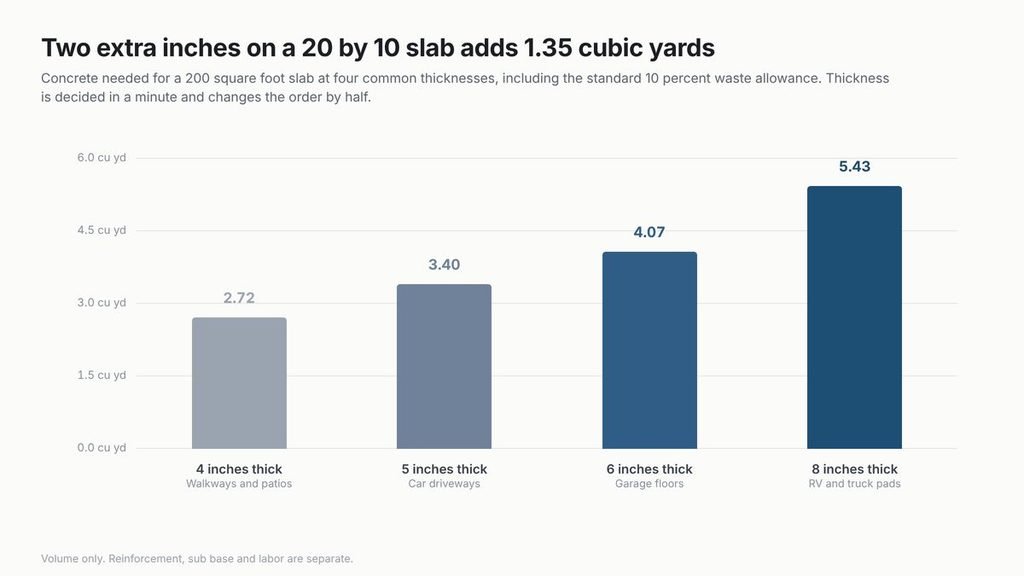
The same 200 square feet at 6 inches instead of 4 is 100 cubic feet, or 3.70 cubic yards, 4.07 with waste. That is 1.35 more cubic yards than the 4 inch version, a jump of 50 percent, from one decision taken in a minute. Thickness is the single biggest lever on the quantity, which is why it belongs at the start of the planning rather than the end.
What a Concrete Calculator Cannot Tell You
A concrete calculator gives you a volume. It does not give you a slab, and the gap between those two things is where most first attempts come unstuck.
Reinforcement. Anything carrying a vehicle needs rebar or mesh, and that is a separate material, a separate cost and a separate ordering decision. The calculator does not know whether you are putting any in.
Base preparation. Concrete poured on soft or uncompacted ground will crack regardless of how thick it is or how good the mix was. Most slabs want 4 inches of compacted sub base underneath, which is its own excavation and its own delivery.
Working time. Once concrete is placed you have a limited window to screed, float and finish it, and in hot weather that window shrinks considerably. The American Cement Association’s guide to working with concrete walks through the order those steps go in, which is worth reading before the truck arrives rather than during.
Curing. Concrete does not dry, it reacts, and that reaction needs moisture. A slab left to bake in the sun for a week will be measurably weaker than the same mix kept damp. Keeping it covered for the first few days costs nothing and matters more than most people realize.
Frequently Asked Questions
How many cubic yards is a 10 by 10 slab?
At 4 inches thick, 1.23 cubic yards, or 1.36 once you add the standard 10 percent. At 6 inches it is 1.85, or 2.04 with waste.
How many 80 lb bags make a cubic yard?
Forty five. Each 80 pound bag yields 0.60 cubic feet, and a cubic yard is 27 cubic feet. For 60 pound bags it is 60, and for 50 pound bags it is 72.
How much concrete do I need per fence post?
For a 4 by 4 post in a 10 inch hole, two 80 pound bags at 24 or 30 inches deep, three at 36 inches. A 12 inch hole takes three bags at 24 and 30 inches, four at 36.
How thick should a concrete driveway be?
Five inches for cars. Six to eight if trucks, an RV or a trailer will use it, with reinforcement. Four inches is for foot traffic and will crack under repeated vehicle loads.
How much extra concrete should I order?
Ten percent on a normal job, fifteen on rough or sloping ground. Running short creates a cold joint, which is a permanent weak line through the slab, so the overage is cheap insurance.
How much does a cubic yard of concrete weigh?
About 3,600 pounds, which is 1.8 tons. That figure is the same whether it arrives in a truck or in bags, which is worth remembering before you load a car with them.
Can I pour a slab in sections?
Only if you plan the joints deliberately. An accidental join, where a second batch meets concrete that has already begun to set, creates a cold joint that stays weak permanently. Planned joints with proper edges are fine, unplanned ones are not.