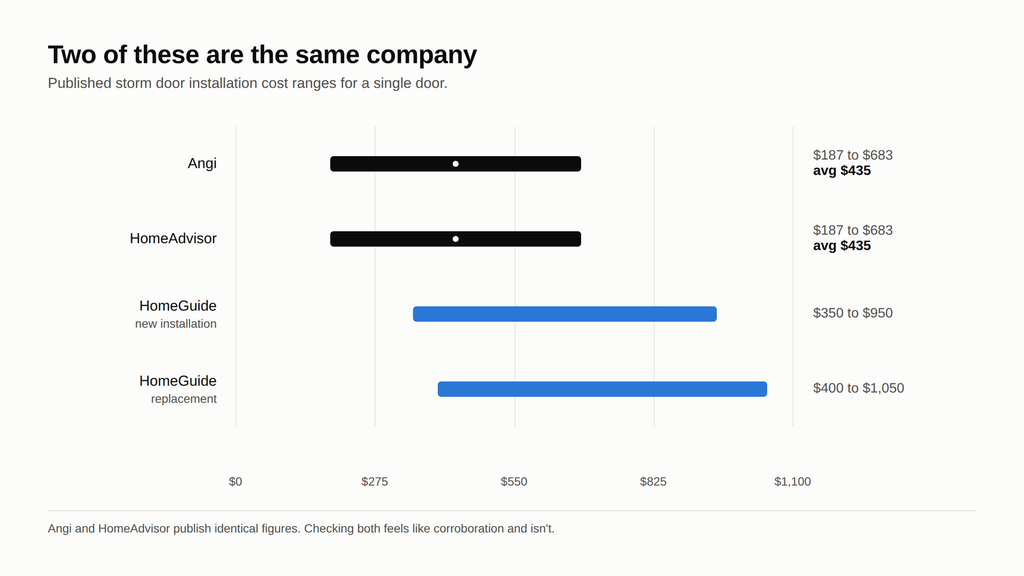
Check two cost websites for storm door installation cost and you’ll get the same answer. Angi says the national average is $435, with most people paying $187 to $683. HomeAdvisor says the national average is $435, with most people paying $187 to $683.
That isn’t two sources agreeing. Angi and HomeAdvisor are the same company, and they publish the same numbers. You’ve checked once.
HomeGuide, which is a genuinely separate source, says a new storm door installation runs $350 to $950, and a replacement runs $400 to $1,050. Its bottom end is nearly double Angi’s, and its top end is a third higher.
Meanwhile Lowe’s has advertised storm door installation at $99.
This guide works through all of it. Where each figure comes from, which ones survive a close look, and what you should actually expect to pay for your own door.
Storm door installation cost, the short answer
For a standard 32 or 36 inch door in an existing frame, expect $350 to $700 installed.
That’s a mid-range door and a professional fitting it in an opening that’s already square and the right size. Cheap end, around $250 for a basic vinyl door that you hang yourself. Expensive end, $1,800 for a double door or a security door with custom sizing.
If you’re replacing an old storm door rather than adding one where there wasn’t one, add $50 to $100 for removal and disposal.
That bracket is more useful than any national average storm door installation cost, for a reason that becomes obvious once you look at how the averages were built.
The number that doesn’t add up
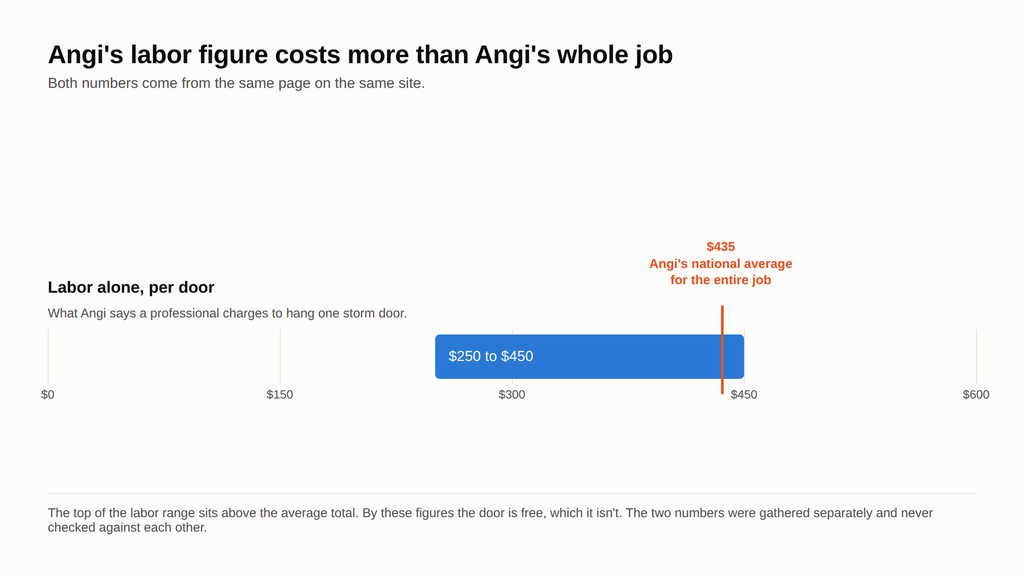
Angi puts the national average at $435 per door, based on 1,298 projects. That’s a specific figure from a real sample, which is more than most cost sites offer.
On the same page, Angi puts labor at $250 to $450 per door.
Read those two together. The top of Angi’s labor range, $450, is more than its stated national average total of $435. By its own figures, the most expensive labor costs more than the whole average job, before anyone has bought a door.
HomeGuide has the same problem in a different shape. Its table says a self-storing storm door costs $375 to $700 installed. Elsewhere on the page it says the kit costs $250 to $400 and labor costs $175 to $350. Add the cheapest kit to the cheapest labor and you get $425, which is $50 more than the bottom of its own installed range.
Its double door row doesn’t reconcile either. Materials at $500 to $1,200 plus labor at $175 to $350 gives $675 to $1,550. The table says $800 to $1,800.
None of this means the sites are lying. It means the installed figures and the component figures were gathered separately, at different times, and never checked against each other. Which is exactly why you shouldn’t plan a storm door installation cost off a single published number.
What the big box stores actually charge
This is the part no cost guide covers, and it’s what a lot of people are actually searching for.
Lowe’s has run storm door installation at $99. That was a promotional offer, and the one I can point to ran from August 21 to September 3, 2025, so it isn’t live now. But promotional install pricing at that level comes round regularly, usually in late summer and early fall when door sales are seasonal.
Ninety nine dollars against Angi’s $250 to $450 is not a small difference. It’s roughly a quarter of the price.
Before you assume that settles it, read the fine print, because the fine print is where the money goes.
A site assessment fee may be charged. It’s credited against your final price if you go ahead, and it isn’t if you don’t.
Minimum labor or purchase charges may apply. That’s the clause that quietly turns a $99 install into something else.
Permit fees are extra, and so is anything that isn’t “basic installation”. Basic installation means hanging a standard door in a frame that’s already sound and the right size. It does not mean fixing your rotten threshold or widening an opening by two inches.
Installation is by independent contractors, not store employees, though it’s backed by the retailer’s labor warranty.
The honest summary: big box promotional pricing is real and worth timing your purchase around, but it covers the simple case only. If your opening needs work, you’re paying trade rates for that work either way.
A storm door and a screen door are not the same thing
Most cost articles use these interchangeably and it costs readers money.
A screen door is a frame with mesh in it. It keeps insects out and lets air through. That’s the whole job.
A storm door has glass as well as screen, usually interchangeable or self-storing, and it’s built to take weather. It protects your main door, adds a layer against drafts, and lets you open the front door in bad weather without the hallway getting wet.
The price gap is large. HomeGuide puts a screen door installed at $175 to $500. A storm door installed is $350 to $950. Roughly double for the storm door.
So if what you want is airflow in summer and nothing more, you can halve your budget by buying the right product. If you want year-round protection for an expensive front door, the screen door doesn’t do that job at any price.
What you pay for by door type
Type matters more than material on a storm door, because it determines how much glass you’re buying and how the ventilation works.
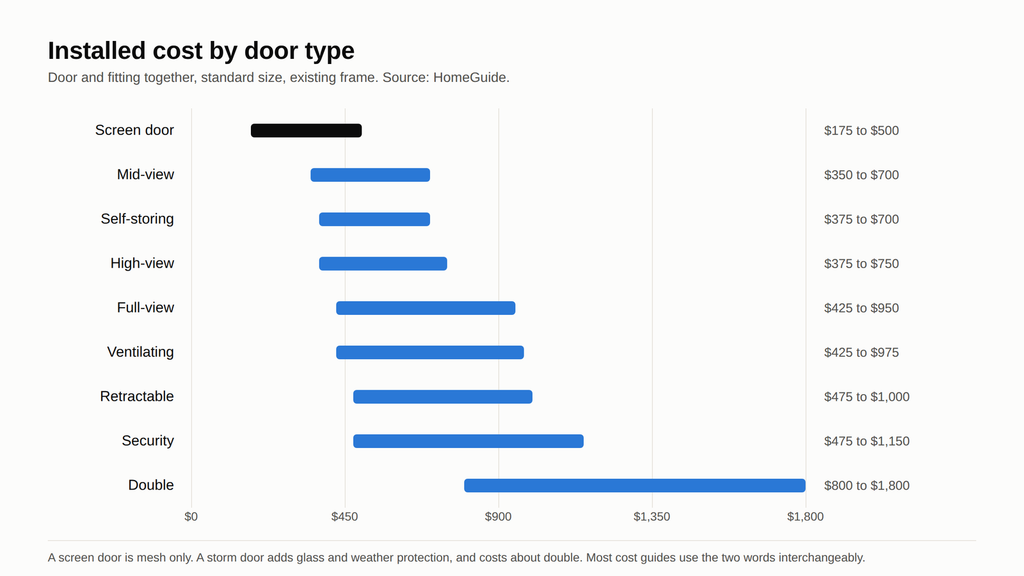
A mid-view door, where the glass occupies the middle section and there’s a solid panel at the bottom, runs $350 to $700 installed. This is the practical choice for a house with children or dogs, because the solid bottom panel takes the kicks.
A high-view door, with glass in the upper portion, runs $375 to $750.
A self-storing door, where the screen and glass panels slide within the frame so you never have to store a panel in the garage, runs $375 to $700. For the small premium this is the one most people are happiest with two years later.
A full-view door, glass top to bottom, runs $425 to $950. It looks best and shows off the front door behind it, and it’s the one that gets damaged most.
A ventilating door runs $425 to $975. A retractable screen door, where the screen rolls away into the frame, runs $475 to $1,000.
A security door, with a reinforced frame and heavier locking, runs $475 to $1,150.
A double door, for a double-width opening, runs $800 to $1,800.
What you pay for by material
Vinyl runs $100 to $500 for the door alone. It’s the cheapest, it won’t rust, and it looks cheap because it is.
Aluminum runs $150 to $500 and is the default for a reason. Light, won’t rot, takes a baked finish, and a decent aluminum door outlasts a cheap vinyl one by years.
Composite runs $150 to $600. Steel runs $150 to $1,000 and is what you want if security is the point.
Wood runs $275 to $1,500. It looks right on an old house and nothing else does. It also needs refinishing every few years, and a wood storm door facing south and west will need it sooner than you think.
One thing worth knowing before you choose on looks. A full-view storm door over a dark-colored front door can trap enough heat in summer to damage the door behind it. Some manufacturers void the warranty on the inner door for exactly this reason. If your front door is dark and faces the sun, a mid-view or a ventilating door is the safer choice.
The energy saving claim nobody checks
Storm doors are sold on energy efficiency. Almost every product listing mentions it.
Here’s something you won’t find in a cost guide. ENERGY STAR does not certify storm doors. The program lists them explicitly under excluded products, as ineligible for certification.
That’s worth sitting with. An entire product category marketed on energy savings, and the federal energy efficiency program won’t rate it.
Compare that with storm windows, which ENERGY STAR does certify. On a house with single pane windows and no existing storms, ENERGY STAR estimates low-e storm windows save around $350 a year on heating and cooling, roughly 10 percent, with a payback of about three years. The Department of Energy puts the range at 10 to 30 percent and notes they can cut overall air leakage by 10 percent or more.
Those are real numbers for a real product. There’s no equivalent for storm doors, because a door is a small fraction of your building envelope and it’s opened and closed all day.
None of which means a storm door is a bad buy. It protects an expensive front door from rain and sun, it lets you ventilate without opening up the house, and it adds a layer of security. Those are good reasons. Just don’t buy one expecting it to show up on your heating bill, and treat any quote built around energy savings with suspicion.
The costs that don’t make the headline
Removal and disposal of your old door is $50 to $100, and all three sources agree on that figure. It’s also a job you can do yourself in twenty minutes with a screwdriver.
Reframing is the one that hurts. HomeAdvisor puts an average reframe at $1,220. If your opening isn’t square, isn’t a standard width, or the threshold has rotted, you’re into carpentry before the door goes anywhere near it. On an older house this is a real risk, not a remote one.
Glass upgrades run $25 to $50 a pane for low-e and $50 to $80 for beveled or tempered.
Custom sizing is the avoidable cost. Standard storm door widths are 30, 32, 34 and 36 inches. If your opening is close to one of those, a competent installer can usually work to it. If it isn’t, you’re ordering custom and the price climbs sharply.
Permits are rarely needed for a storm door on an existing opening, but they’re extra when they are.
And the one people forget. If you’re having the door delivered to a store for installation, check whether the installer’s quote assumes you’ve already got the door on site. Several of the published labor figures do.
Should you install it yourself?
A storm door is one of the more realistic DIY jobs on a house, and the savings are meaningful. HomeAdvisor puts DIY savings on labor at $75 to $400. Budget kits start around $100.
What makes it achievable is that modern storm doors come as a kit with a pre-hung frame. You’re screwing a frame into an existing opening, not building anything.
What makes it go wrong is the same thing that catches people out on cabinet installation. Openings are rarely square. If you fix the frame to a crooked opening, the door won’t close against the seal evenly, and you’ll have a draft at the top or the bottom that no amount of adjustment fixes.
The test before you commit: measure the opening width at the top, the middle and the bottom, then the height on both sides. If those measurements are within a quarter inch of each other, it’s a straightforward afternoon. If they’re out by more, get a quote, because the installer is going to earn their money on the packing and shimming rather than the hanging.
Who should actually fit it
Three options, and the price gap between them is wider than the quality gap.
A handyman is the cheapest route for a straightforward swap. Angi puts handyman rates at $30 to $40 an hour. HomeGuide puts them at $50 to $80. That’s a two-fold difference between two cost sites on the same trade, which tells you how loose these figures are and why you get your own quotes. Either way, two to three hours on a standard opening means $60 to $240 in labor, well under the $250 to $450 the same sites quote as the storm door installation cost.
A door or window contractor charges $40 to $90 an hour and is worth it when the opening needs work. They’ll have the packing, the shims and the flashing on the van, and they’ve dealt with a rotten threshold before. On an older house this is the call.
A big box installer sits between the two on price and is the most predictable on the simple case. Standard door, sound frame, fixed price, labor warranty. The trade-off is that anything outside basic installation gets priced separately and you have less room to negotiate it.
What this comes down to: if your opening measures square and the old door comes off cleanly, you’re paying for two hours of straightforward work and you should not be paying $450 for it. If the opening is out, or the threshold is soft, pay the contractor rate and be glad you did.
One thing worth asking whoever you hire. Will they take the old door away? Some will fold it into the price, some charge the $50 to $100 separately, and some leave it leaning against your garage.
How to read a storm door quote
Ask whether the price includes the door or is labor only. This is the single biggest source of confusion in the published figures and it’s the same question that matters on a quote.
Ask what happens if the opening needs work. Nobody can tell you that until the old door is off, but you can agree an hourly rate for it in advance rather than discovering one after.
Ask whether removal and disposal is included, since it’s a $50 to $100 line item that sits in some quotes and not others.
Ask whether the price is for a standard size. If your opening is 33 and a half inches, you need to know now whether that means custom pricing.
And check the warranty on your existing front door before you buy a full-view storm door, particularly if the front door is dark and faces the sun.
Frequently asked questions
How much does it cost to install a storm door?
A standard door in a sound existing frame costs $350 to $700 installed. Labor on its own is $175 to $450 depending on whose figures you use, and big box promotional pricing has gone as low as $99 for basic installation.
How much does it cost to replace a storm door?
Replacement runs $400 to $1,050 according to HomeGuide, which is slightly more than a new installation because it includes removing and disposing of the old door at $50 to $100.
How long does it take to install a storm door?
Two to three hours for a professional on a standard opening. Allow most of a day if you’re doing it yourself for the first time, and more if the opening needs packing out.
Is a storm door worth it?
For protecting an expensive front door from weather and sun, and for ventilating without opening the house up, yes. For energy savings, be skeptical. ENERGY STAR won’t certify storm doors for efficiency at all.
Can I install a storm door myself?
Yes, if your opening measures square within about a quarter of an inch. Modern doors come as pre-hung kits. The skill is in dealing with an opening that isn’t true, which is also where DIY installs fail.
What size storm door do I need?
Standard widths are 30, 32, 34 and 36 inches. Measure your opening at the top, middle and bottom and work to the narrowest measurement. Anything that doesn’t match a standard width means custom pricing.
Putting a number on your own door
Measure the opening, width and height, in three places each.
If it’s a standard width and square, budget $350 to $700 for a mid-range door fitted, or around $250 if you’re doing it yourself.
Add $50 to $100 if an old door is coming off.
If the measurements are out, or the threshold is soft, get a carpenter to look before you order anything. Reframing at an average of $1,220 is the cost that turns a cheap job into an expensive one, and it’s the only one worth knowing about in advance.
Then decide what the door is actually for. Protection and ventilation are good reasons to buy one. If someone is justifying a storm door installation cost on the basis of what it’ll save on your heating bill, ask them why the federal program that rates storm windows won’t rate storm doors.
